Scientific Method 2.0 – Science Grounded in Life Value
One project I am developing is a revised curriculum for science education, or for art, science, technology, engineering, and math (ASTEM) education. This is described a bit in the R&D Projects post.
One idea is to reform science education to address the value basis of science. The need for this is explained in several places (see the post Mission Possible) and the main point is to reform science toward solving the global ecological multi-crisis.
The value basis of science is an interesting topic. One of the key foundational pillars of conventional mainstream science is the emphasis on being value neutral. This principle is often linked to the necessity that science not be biased by any emotional, political, personal, commercial, or other non-scientific influences.
This key value, and related principles, have been widely accepted, and they may seem necessary and common sense. However, work to understand the root causes, and strategies for solutions, in our current world ecological crisis, leads to profound assessment that this value basis is actually very weak.
I have been a student of science, and a practicing scientist, for more than 30 years. I respect and trust science, and I rely on the scientific approach in many aspects of my life. My field within science is ecology, and through the discipline of ecological science I have learned many principles of living systems, their environments, and the relationships between. It is my discipline of ecological science that has helped me realize that science itself requires an examination.
The reason the value-neutrality of science is weak, is that without any asserted and explicit value basis, science can be used for essentially any purpose. The uses, and the relative good or bad outcomes, are left to other realms beyond science. Decisions, choices, and judgements are left to the good conscience of folks in technology, industry, commerce, and culture. Or, perhaps left up to governments, or courts, etc.
If science, and we in communities of practicing scientists, wish to participate and to be effective in solving the global ecological multi-crisis, we need to examine the full range of issues related to the value basis of science.
To start, I present a few general conceptual diagrams and thoughts that illustrate some of the relationships. I present these as hypotheses, working models, and as starting point for more questions. I would appreciate your comments, feedback, and criticism toward improving this work.
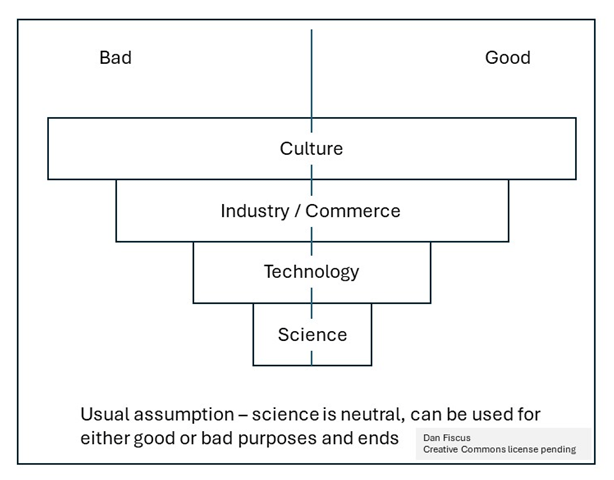
First, a depiction of the usual assumption – science is value neutral, and applications and outcomes of science can be assumed to be anywhere on the spectrum from good to bad.
The realms above science – these could all be redrawn as spheres – are based on the idea that in industrial culture, the basis of our culture is science. This article focuses on industrial culture and does not address indigenous cultures.
The top level with “Bad” and “Good” can be considered general outcomes for society. We could add very many distinctions to address “good and bad for what?” But these are left generalized to start.
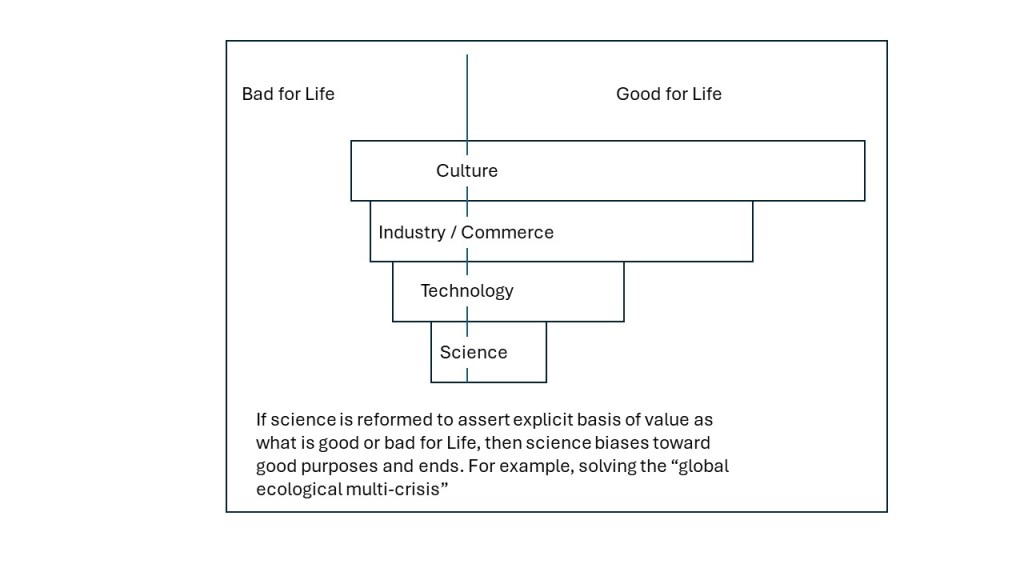
The first diagram may seem OK, like a picture of balance. The problem comes in when we choose to assert an explicit value basis for the top level – for society, or for humanity. If we base value on Life – where Life is taken to mean Life itself, Life as a unified whole, all organismal-ecosystemic-biospheric Life of Earth as one – then we get a different picture.
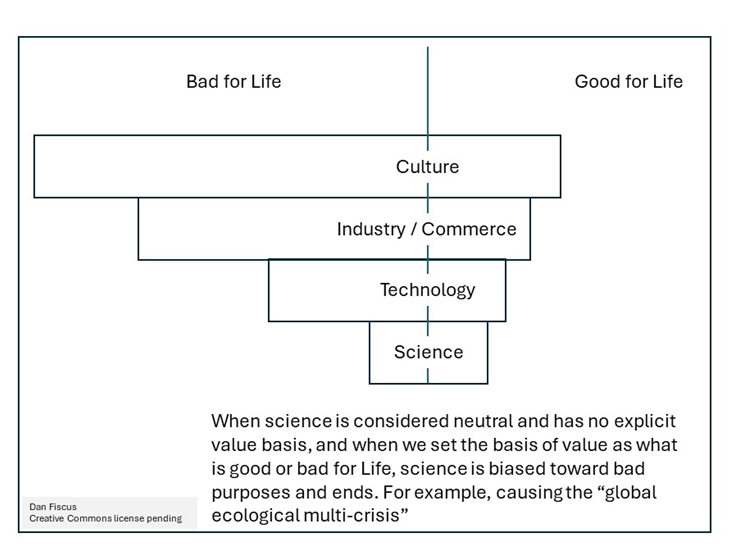
Now we can envision that, despite the intention to prevent bias by asserting value-neutrality, science has in fact been biased toward outcomes that are bad in the sense of bad for Life itself.
The main source of evidence for this hypothesis is the global ecological multi-crisis. Three ways by which the value basis of science can be linked to planetary crisis symptoms are 1) science is the basis of industrial culture, 2) the paradigm of a complex system has maximum leverage for change to the system (Meadows 1999), and 3) another foundational pillar of conventional science is the idea of mechanism.
The imbalance starts with science itself – the bias toward a mechanistic, analytical worldview is inherently lacking in awareness of Life, which is non-mechanistic and holistic.
Then as science is applied, people and organizations in technology, industry, commerce, and culture can amplify the science / worldview bias and make outcomes much more harmful for Life.
In short, we have turned the world into the machine science has imagined it to be. This outcome is driven partly by science’s lack of explicit value basis, and partly by the mechanistic root metaphor. Mechanisms are inherently entropic, and they degrade their environments as they operate. By thinking in terms of mechanisms, starting in science and then permeating all industrial culture, we have projected and imposed entropic environmental degradation onto the natural world. This is despite the fact that living systems show the opposite system properties and naturally improve the environment over time.
We have another option.
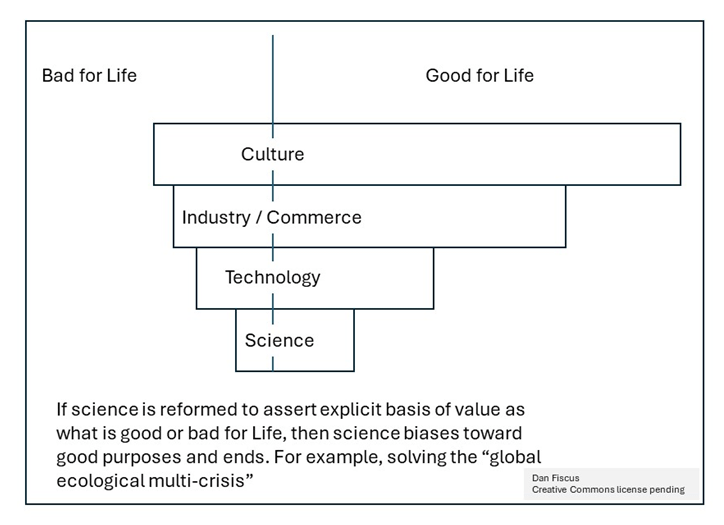
If and when we assert that science exists in service to Life, then we can bias science toward applications and outcomes that are beneficial for Life. The urgent example is that we need to solve all 10 to 20 of the simultaneous existential ecological crises (of direct human Life-support consequence) we now face.
How can we do this?
This is where the basic ASTEM Education comes in. We need to start over with what the scientific method is, and how we teach science, at the very beginning of education.
To recap something many of us have heard thousands of times…here is the standard description, one borrowed from the American Museum of Natural History
https://www.amnh.org/explore/videos/the-scientific-process
“The Scientific Method is a dynamic and open-ended process that scientists use when they investigate a question they have. It is not a series of prescribed steps that scientists follow to prove a hypothesis. Rather, it’s a general plan that helps guide their investigation. And while all scientists use the Scientific Method, they might not use all the steps, or they may complete the steps in a different order. For example, a scientist might make observations and collect data about a subject that interests him or her for years before formulating a hypothesis.”
They describe these steps in the process:
1. Defining a question to investigate
2. Making predictions
3. Gathering data
4. Analyzing the data
5. Drawing conclusions
This sounds great in these process steps. Although there is no mention here of value-neutrality, prohibiting bias, remaining objective, or thinking in terms of mechanisms, these other values and principles come into play as science is taught and practiced. Just as there is nothing inherently bad for Life in the conventional recipe for science, there is also nothing to prevent the method from being used to harm Life itself.
Here are steps for a proposed revised scientific method:
1. Reflecting on and reaffirming the value basis for scientific research – to serve Life
2. Reflecting on and reaffirming that engaging in science alters the world – science is not inert (for example, see “observer effect”)
3. Taking full responsibility for the direct and indirect impacts of one’s scientific activities
4. Thorough evaluation of the intended, known, and potential impacts of one’s scientific activities to ensure that the results will improve the quality of Life, or at least not harm the quality of Life
5. Defining a question to investigate
6. Making predictions
7. Gathering data
8. Analyzing the data
9. Synthesizing data, theory, and paradigm considering the value of Life
10. Drawing conclusions
11. Follow up monitoring to test, confirm, or challenge the assessment of net positive improvement for Life
I predict that a revised scientific method like this could help solve the global ecological multi-crisis. Admittedly, many other issues must be considered, discussed, and incorporated. The same Life value basis described here as helping to ground and re-orient science can similarly aid those other considerations and discussions.
To assert and embody the value of Life does not bias science toward any “special interests”, and it does not promote falsifying data or results. Life is shared by all people and all of Life, and without Life and healthy Life-support, no other human pursuits are possible, including science itself.
In addition to great leverage for solving the crisis, I see it possible that such science reform could improve the public opinion and value of science. The strength of a solid grounding, and the transparency of clear values, could increase public understanding, trust, and respect in science. The alignment of science with serving Life could increase the value of science itself.
References cited:
Meadows, D., 1999. Leverage Points: Places to Intervene in a System. Sustainability Institute. Hartland, VT, USA.


 ecosystemics.org
Leave a comment