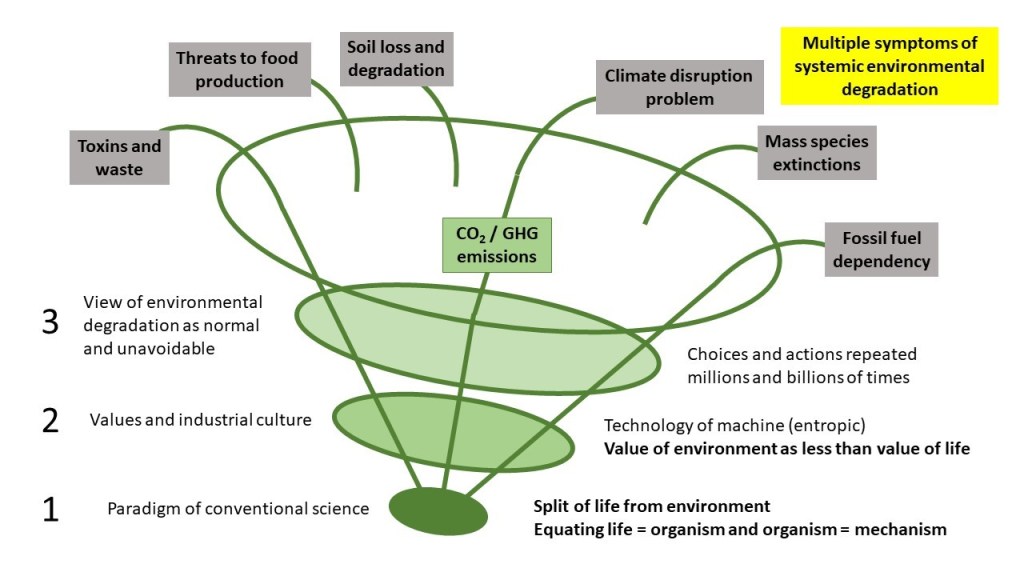
Or “Turning 100 Corners”. Or “Solving Our Multi-Crisis Mess”
One can make an excellent case that our greatest challenge now, and greatest priority should be, solving our global ecological multi-crisis “mess”. Russell Ackoff (1974) used this term…and he coined it with poetic power. He wrote:
“English does not contain a suitable word for ‘system of problems’. Therefore, I have had to coin one. I choose to call such a system a mess.”
And soon after:
“The solution to a mess can seldom be obtained by independently solving each of the problems of which it is composed.” (p. 21)
Brian Fath and I proposed a strategy for solving our global ecological multi-crisis mess – to change the paradigm of science. Our reasons for proposing that strategy, and the details of how that strategy would be implemented, are covered in our book and elsewhere on this website.
In this post, I want to describe how we could tell if the strategy and its implementation actions for transformative change in science, technology, and culture are working. What evidence, information, observations, experiences, or other indicators would serve as an effective basis to determine that the strategy is working?
Following Ackoff’s excellent advice and wholistic guidance, we could look for signals that we have begun to solve not just one or a few sub-problems of the overall, monstrous, interdependent mess. That is, we could look for evidence that ALL (or perhaps most, or the vast majority) of the symptomatic sub-problems are turning the corner in synchrony.
Examples of quantitative and well-documented trends we could monitor include those reported in the Great Acceleration article (Steffen et al. 2015). Seven of these important Earth system trends were updated in 2020 and are shown in graphs in the figure (Ripple et al. 2020). For all seven of these, and more we could monitor, to turn the corner in synchrony plausibly would indicate that the solution to the mess was working.
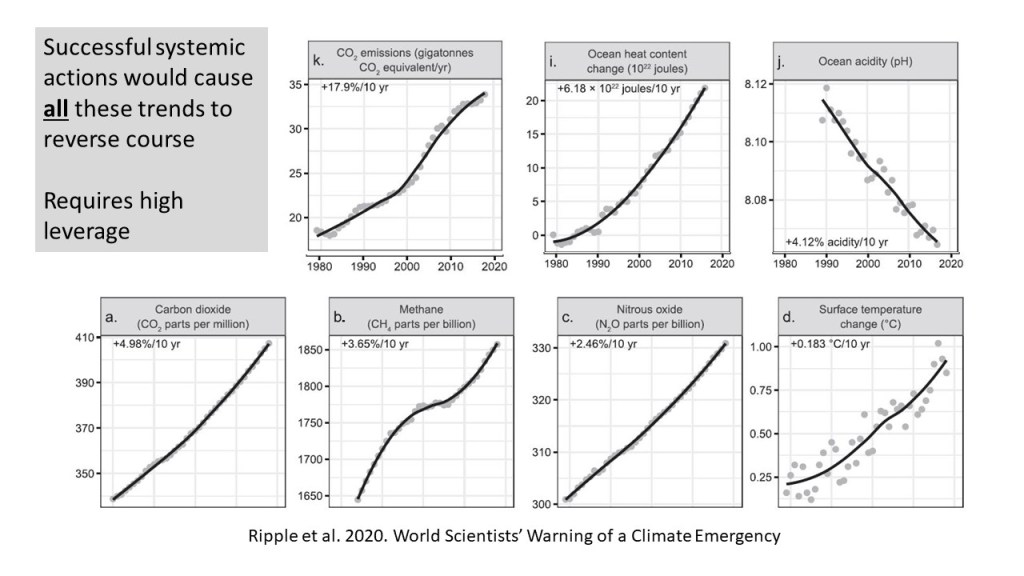
That (in my view) is a proposed solution worth testing, and a pragmatic means to test it.
Another benefit of framing the problem, solution, and indicators of success both holistically and in detail is this can yield information in the negative space. Again with the help of Ackoff, we now have two ways to determine that no solutions so far being implemented are effective or successful. If we see none of the Great Acceleration trends turn the corner, plateau and then reverse course, that can indicate that no solutions are working at all. Or, if we see only a single of the mess sub-problems turn the corner, we’d be on the alert for other indicators. For example, some recent solutions have yielded progress on a single sub-crisis at the expense of creating a new sub-crisis, or making one or more other sub-crises worse. So the framing-plus-indicators works both ways – to signal when actions are working and when actions are not working. The clear implication of a signal that no actions are working? TRY SOMETHING NEW!!!
I’d appreciate any comments, corrections, ideas, suggestions, pointers, or reflections on this. Oh, and I guess we should be thinking of a new term to go with Ackoff’s mess. What is a good word to describe “a system of solutions”? Hmm…
References cited:
Ackoff, R.L. 1974. Redesigning the Future: A Systems Approach to Societal Problems. Wiley, New York, NY.
Fiscus, D.A. and B.D. Fath. 2019. Foundations for Sustainability: A Coherent Framework of Life-Environment Relations. 292 pp. Academic Press, Elsevier. Cambridge, MA. USA. Book website is here: https://www.elsevier.com/books/foundations-for-sustainability/fiscus/978-0-12-811460-5
Ripple, W. J., C. Wolf, T.M. Newsome, P. Barnard, and W. R. Moomaw. 2020. World scientists’ warning of a climate emergency. BioScience, 70(1), 8-12. https://doi.org/10.1093/biosci/biz088
Steffen, W., W. Broadgate, L. Deutsch, O. Gaffney, and C. Ludwig. 2015. The trajectory of the Anthropocene: The Great Acceleration. The Anthropocene Review, 2(1), 81-98. https://doi.org/10.1177/2053019614564785

 ecosystemics.org
Leave a comment