
A Two-for-One Energy Transitions Deal – Step Right Up!
[Cover image of sugar maple seeds from here]
I recently realized I could find allies, form a team, and get into a $trillion sustainability game. Here’s the deal, in case you want to join, or hear about the opportunity, or help improve the game plan.
First though…money – like science, technology, and culture – is in dire need of systemic total overhaul, as I wrote about here citing work of Alf Hornborg and others. I will set aside those issues for now for the sake of this discussion about the multi-trillion-dollar energy transition. But eventually, we need to transform the money system, too.
The World Energy Outlook (WEO 2023) report of the International Energy Agency (IEA) gives information and projections for world energy demand, supplies, and related technologies.
This report describes several scenarios for a “clean energy” transition, and why it is important for the climate crisis and social needs. The report depicts investments of $3 to $4 trillion annually starting immediately and continuing for coming decades.
I submit that the underlying assumptions and strategy proposed in this report are deeply flawed. I propose an alternative vision for energy transition viewed through the lens of the science paradigm grounded in living systems and the value of Life described in Fiscus and Fath (2019) and on this website.
Some valuable highlights of the IEA WEO (2023) report follow, as well as pointing out the foundational flaws.
Key factors of the report underscore “…the frailties of the fossil fuel age, and the benefits for energy security as well as for emissions of shifting to a more sustainable energy system.” p. 23
The report describes major global trends and how they relate to their three futures scenarios: “…clean energy is the most dynamic aspect of global energy investment. How fast it grows in the coming decades in response to policy and market stimuli is key to explain the differences in trajectories and outcomes across our three main scenarios.” p. 23
A key finding is: “In all scenarios, the momentum behind the clean energy economy is enough to produce a peak in demand for coal, oil and natural gas this decade…” p. 23
Importantly, their three future projection scenarios differ in energy demand trends:
“In the Stated Policies Scenario, average annual growth rate of 0.7% in total energy demand to 2030 is around half the rate of energy demand growth of the last decade. Demand continues to increase through to 2050. In the Announced Pledges Scenario, total energy demand flattens, thanks to improved efficiency and the inherent efficiency advantages of technologies powered by electricity – such as electric vehicles and heat pumps – over fossil fuel-based alternatives. In the Net Zero Emissions by 2050 Scenario, electrification and efficiency gains proceed even faster, leading to a decline in primary energy of 1.2% per year to 2030.”
I see their Net Zero Emissions by 2050 Scenario (NZE Scenario) as the best scenario, as it is the only one forecasting a decline in energy demand.
For this energy transition scenario, the report estimates investments needed in “clean energy”. These are summarized and broken down by economic groups of nations in their Figure 1.18:
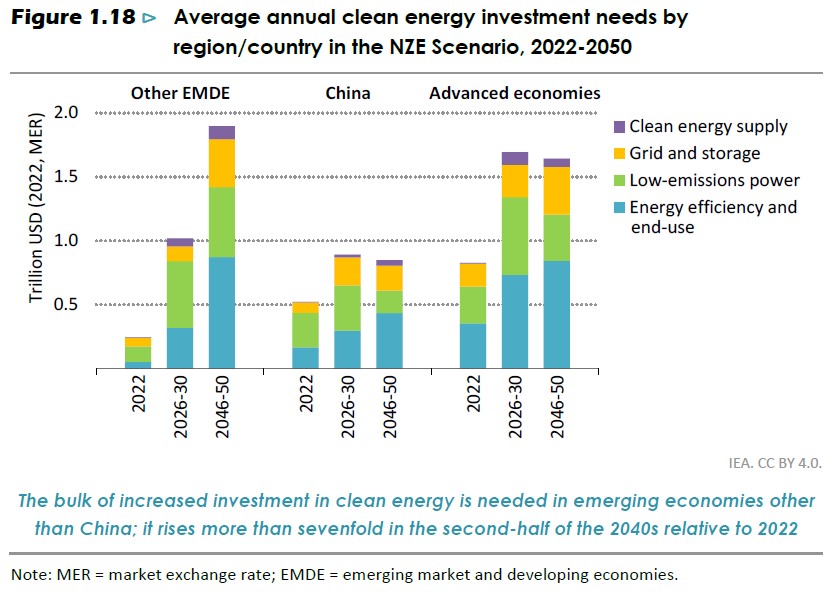
Figure 1.18 from WEO (2023) p. 47
From this figure, total world annual investments required in clean energy are $3.5 trillion for 2026 to 2030 and $4.25 trillion for 2046 to 2050. Trillions $$$…annually.
The WEO report acknowledges important factors – the need for energy demand to decline, and the connection between energy and critical mineral resources. However, it lacks a holistic understanding of science, technology, ecology, and environmental Life support systems. Without these changes, I see no evidence or scientific theoretical basis to support the belief that the trillions invested annually will succeed in fostering a truly sustainable and just energy transition.
The IEA WEO report does not depart significantly from the “conventional wisdom” of industrial culture and its underlying reductionist, objectivity-focused, analytical, mechanistic (ROAM) scientific worldview. Their scenarios depict declining demand for fossil energy sources (oil, coal, gas) to be driven mainly by economics – renewable energy is becoming less expensive, and it will increasingly out-compete fossil energy in the marketplace. Note: this relies on the same market economy that caused the global social-ecological multi-crisis.
Their three scenarios carry assumptions that maintain core aspects of industrial culture and its underlying ROAM science paradigm and ideology. “Business as usual” aspects of high energy intensity and economic growth, among others, are not realistic in light of the systemic framework described in our book (Fiscus and Fath 2019) and on this website. The incremental technological advances they foresee do not address crucial principles missing in industrial technology; two of great importance are 1) how Life-Environment systems self-organize for sustainability over the very long term, and 2) a value basis in science, technology, and culture focused on Life itself, Life as a unified whole.
Without such foundational scientific, worldview, and value system changes, the IEA WEO scenarios are not likely to succeed in an energy transition that is truly sustainable, that reverses the causes of climate disruption, and that is truly just. At best, their approach is delaying the inevitable. More likely, it will make matters much worse. It is aligned with techno-optimism (see prior post here) and proposes a suite of “solutions” that may feel good in the short term but add more problems in the long term. Their investment portfolio will not only fail the climate emergency but will perpetuate the same environmental degradation, resource depletion, wealth inequality, fighting over scarce resources, warfare, and related dysfunction we see now.
A better approach: See “the energy transition” as two distinct and complementary energy transitions.
I think strategies and scenarios like those in WEO 2023 continue to be proposed due to the disconnect between the radical transformative change people intuitively understand needs to occur compared to 1) our habituation to and dependence on high energy intensity technology and culture, and 2) a lack of viable and scalable technologies able to maintain the high energy lifestyle while also being climate neutral and fostering regeneration of environmental Life support systems. Sensing that the change needed is unobtainable is like the proverbial driving directions advice – “you can’t get there from here”. Faced with what seems impossible, many people revert to the same old same old.
The missing piece here is the courage, will power, and/or bull-headed determination to figure out how to do the radical transformation truly necessary so we can all get on with Life, solve the climate crisis, and solve the larger global social-ecological multi-crisis.
The strategic approach to envision two different futures can help, and it fits fully with the history and core organizing principles of Life-Environment systems. To discern and synthesize that we need two radically different types of energy future is to open up possibilities. We create the possibility to get past the roadblock of thinking we can’t live the way we now live, but we have no other option.
I refer to the first of two proposed complementary energy transitions as the “Prosperous Way Down”, based on the book by Odum and Odum (2001).
I call the second energy transition “Prepare to Launch”, based on the theme of the Tech and the Gap conference of 2022 (see conference video link here).
This dual strategy scenario has a much better chance to succeed. It follows Life’s nearly 4 billion year track record of success, a history which has successfully navigated several major energy transitions (see especially the Great Oxygenation Event).
The “Prosperous Way Down” Transition
In this scenario, a key aspect is a rapid decline in energy demand, energy use, and energy intensity of all aspects of industrial culture. I will talk mainly about industrial culture, as these are the industrial systems causing the climate and larger systemic crisis, not indigenous cultures. In fact, in this scenario indigenous cultures are the model and indigenous peoples are the leaders.
In our book (Fiscus and Fath 2019) we wrote of two hypothetical cultural types, “Sustainers” and “Transcenders”, and this Prosperous Way Down scenario is the Sustainer scenario. Indigenous people and those practicing true sustainability lead the way. “True sustainability” here means human systems using 100% renewable energy, 100% recycling materials processes, and net positive impact on the quality of Life, Environment, Life-Environment system, and human life on Earth. In this scenario energy consumption needs are reduced to the lowest level possible – energy necessary to support true needs (not frivolous wants). With this radically lower energy intensity, it becomes possible to design and scale systems that are truly sustainable. This transition pathway acknowledges Hubbert’s peak oil data (Hubbert 1962), the fact that humans met basic necessities before fossil energy, and the fact that we will have to survive without fossil energy over the long term anyway. This pathway includes discussions about what technologies, advances, and resources to borrow from industrial culture and convert to true sustainability. To borrow yet inspiring book title, this transition will be about “Becoming Native to this Place” (Wes Jackson 1993), where this place is Earth.
The complementary, simultaneous, parallel, coordinated energy transition is “Prepare to Launch”. This is a radically divergent energy transition and one that aligns with the Transcender mission.
As mentioned, the two future strategy fits with the ecology of all Life – living systems always employ dual modes of “sustain in one place” and “disperse to a new place”. For thoughts on how the Transcender mission associated with space exploration and space travel can catalyze and co-create the Sustainer mission, see here.
This energy transition strategy will require energy uses and technologies, and associated investments, to advance the missions of folks like the Space Ecology Workshop (amazing group who understand ecology well), NASA, European Space Agency, and related “authentic” space communities. I don’t see efforts led by Musk, Bezos, etc. with their ego trips to be authentic as in serving Life and humanity, but perhaps some of their efforts do help and should be integrated. This Prepare to Launch branch of the human / Life future will need fossil energy much more than the Sustainer branch. However, this two-energy-transition strategy could include a 10- or 25- or 50-year moratorium (or drastic reduction) on fossil energy use to stabilize Life support systems on Spaceship Earth.
The two-energy-transition strategy is worth discussing and developing in part because it is different than currently discussed scenarios, which are nearly certain to fail as have all other so-called solutions based on ROAM science and industrial culture worldview.
This strategy is also unique in the way it seeks to channel or re-direct the otherwise horrible impacts of ROAM science and mechanistic industrial technology toward an ultimate mission and purpose that serves Life in essential ways rather than threatening Life, destroying Life support systems, and causing more harm to people and planet. To channel and redirect the massive ROAM science and industrial tech juggernaut seems more practical and fruitful than trying to fight it or regulate it. And it may work more quickly than if we wait for a Kuhnian paradigm shift when old guard ROAM scientists die off; more quickly than waiting for a near-death disaster to serve as wake up call for industrial humanity to change.
This embracing of the Transcenders and space frontier is not like the techno-optimist approach to solve problems in isolated ways that backfire. This is holistic, systemic, and based on Life value, and the “Life dispersal systems” involved truly serve Life in a unique way that no other species besides humans can do. I really love chimps, and dolphins, and a million other species but I’m sorry – none of these adorable living creatures are going to deflect massive rocks coming from space, or figure out how to get to another star before ours burns out. The Space Ecology Workshop I participated in taught me that many space community folks understand and value ecology and sustainability. They seem to take it more seriously than those of us lulled into complacency by the massive buffering capacity of Earth do. We can learn a lot from them.
There are many tricky details related to all these ideas, and I don’t pretend they are perfect or the only good ones around. But I do think they are important, grounded in ecology and holistic, organic, living system (HOLS) science, and worth discussing, developing, and testing given the crisis we face. I think they are unique and original combinations that build on contributions of myriad others…and I am looking for opportunities to work together on these, to improve them, get funding, and put them into action.
Heck, we don’t even need trillions of dollars for these two coupled complementary energy transitions. A meager $1 billion would be a reasonable request to develop, prototype, and test a viable and innovative dual strategy! It’s two-for-one deal at less than 1/1000th the price!
This proposal gives us real choices. The two paths are both viable – they both contain real Life. The single monocular path of continuing industrial culture and its energy machinations has no Life in it. Do a gut check, and/or synthesize mountains of science and works of great writers, thinkers, and activists, or look out the window, and it is clear – the current trajectory is a literal death spiral. Neither the Prosperous Way Down nor the Prepare to Launch paths are easy, but they are supported by Life’s history and ways of being. If we clarify and channel the unique and unified sustaining and dispersing lessons of Life, and invest our energy wisely, we can count on all Life getting better.
References cited
Fiscus, D.A. 2013. Life, money and the “deep tangled roots” of systemic change for sustainability. World Futures: The Journal of Global Education 69(7-8): 555-571.
Fiscus, D.A. and B.D. Fath. 2018. Foundations for Sustainability: A Coherent Framework of Life-Environment Relations. 292 pp. Academic Press, Elsevier. Cambridge, MA. USA. Book website is here: https://www.elsevier.com/books/foundations-for-sustainability/fiscus/978-0-12-811460-5
Hubbert, M.K., 1962. Energy Resources: A Report to the Committee on Natural Resources. National Academy of Sciences. National Research Council, ISBN: 978-0-309-35515-5. 153 pp. Available online at: http://nap.edu/21066.
Jackson, Wes. 1993. Becoming Native to This Place. University Press of Kentucky.
Odum, H.T., Odum, E.C., 2001. A Prosperous Way Down: Principles and Policies. University Press of Colorado, Louisville, CO, 344 pp.
Space Ecology Workshop. https://spaceecologyworkshop.com/
Tech at the Gap conference 2022. “Prepare to Launch”. Conference video link here https://www.youtube.com/watch?v=sJx05ZWqQSM)
Waits, Tom. Song “Step Right Up” https://open.spotify.com/track/2w78IVFn0nad1tcG5RHyTx?si=c66dc80e3543463e
World Energy Outlook (WEO) 2023. https://www.iea.org/reports/world-energy-outlook-2023
 ecosystemics.org
Leave a comment