[Cover art by Cole Fiscus]
I read an incredible article in the March print issue of The Atlantic – “The Despots of Silicon Valley”. This brilliant article by Adrienne LaFrance critiques the “tantrum prone and immensely powerful kings of tech” like Zuckerburg, Musk, and others.
The connection to ecosystemics.org is that LaFrance clearly describes the underlying ideology and values of the high-tech multi-billionaires and associated Silicon Valley corporations. She makes an excellent case that underlying beliefs and values are the cause of the warped and negative human impacts we are experiencing from social media and AI, and she identifies the ideology and values as the real danger.
The ecosystemics.org approach is the same for a related crisis – to identify the deepest root causes of the surface symptoms of ecological crisis we see, and to focus clearly on the root cause as the root of systemic solution.
I think the similarity is important to explore. The underlying beliefs and values that can solve the global ecological multi-crisis may overlap almost completely with those needed for us to take back the internet, social media, and much of our economy and culture in the U.S. from the tech king despots.
The dangerous flaws in the despotic Silicon Valley worldview can be corrected with the help of holistic organic living system science, and its basis of value grounded in Life itself. The associated alternative beliefs, values, and technologies are solidly scientific as well as socially just, ecologically intelligent, democratic, and economically sound.
LaFrance describes how many of the effects of YouTube, Instagram, Facebook, Twitter/X, and others, and parent companies like Google, Meta, and others, have been “damaging to individual rights, civil society, and global democracy”. She also says, and explains why, we can expect more of the same, and worse, from generative AI.
This perspective is powerful and important, but the next step is much more so. She digs down to find the root issues:
“The behavior of these companies and the people who run them is often hypocritical, greedy, and status-obsessed. But underlying these venalities is something more dangerous, a clear and coherent ideology that is seldom called out for what it is: authoritarian technocracy.”
She calls out the overall “clear and coherent ideology”, and then characterizes the components, the foundational principles, values, beliefs, and mottos. Both angles are amenable to describing an alternative coherent system of ideas and its interdependent principles.
The “eccentric beliefs” of the techno-despots she identifies include:
“…that technological progress of any kind is unreservedly and inherently good; that you should always build it, simply because you can; that frictionless information flow is the highest value regardless of the information’s quality; that privacy is an archaic concept; that we should welcome the day when machine intelligence surpasses our own. And above all, that their power should be unconstrained.”
LaFrance quotes from “The Techno-Optimist Manifesto” of Marc Andreessen.
(Note: the manifesto website would not let me share the link, but can be found by searching).
This she says is “a revealing document, representative of the worldview that he and his fellow technocrats are advancing.” She quotes parts of it, including the first sentence here, but the rest here came from the manifesto directly:
“We believe that there is no material problem – whether created by nature or by technology – that cannot be solved with more technology.
We had a problem of starvation, so we invented the Green Revolution.
We had a problem of darkness, so we invented electric lighting.
We had a problem of cold, so we invented indoor heating.
We had a problem of heat, so we invented air conditioning.
We had a problem of isolation, so we invented the Internet.
We had a problem of pandemics, so we invented vaccines.
We have a problem of poverty, so we invent technology to create abundance.
Give us a real world problem, and we can invent technology that will solve it.”
There are multiple tragic flaws in the authoritarian technocracy worldview and its modus operandi. Many can and must be corrected with the help of holistic organic living system science and its basis of value grounded in Life itself. Andreesen also makes a few points with which I can agree; if you read it you can pick and choose and get your own full sense of it.
LaFrance wrote of Andreesen’s manifesto: “This position, if viewed uncynically, makes sense only as a religious conviction, and in practice it serves only to absolve him and the other Silicon Valley giants of any moral or civic duty to do anything but make new things that will enrich them, without consideration of the social costs, or of history.”
The alternative set of beliefs and values described on the ecosystemics.org website as solutions to the global ecological multi-crisis can aid the solutions to techno-authoritarianism LaFrance recommends. The ecosystemic alternatives are described starting with science, but they are also socially just, ecologically intelligent, democratic, and economically sound.
The tech-bro-optimist ideology claims to be scientific, but it is not scientific – LaFrance describes it rightly as “religious conviction”. It is “religious” in the bad sense of that word. It indicates a kind of blind and dogmatic faith is operating without benefit of sensory information, learning from diverse experience, wisdom from lived experience, or environmental or social awareness, understanding of history, or community and cultural context. We know this because the manifesto shows near complete ignorance of the sciences of biology, ecology, thermodynamics, and other branches of science, as well as history.

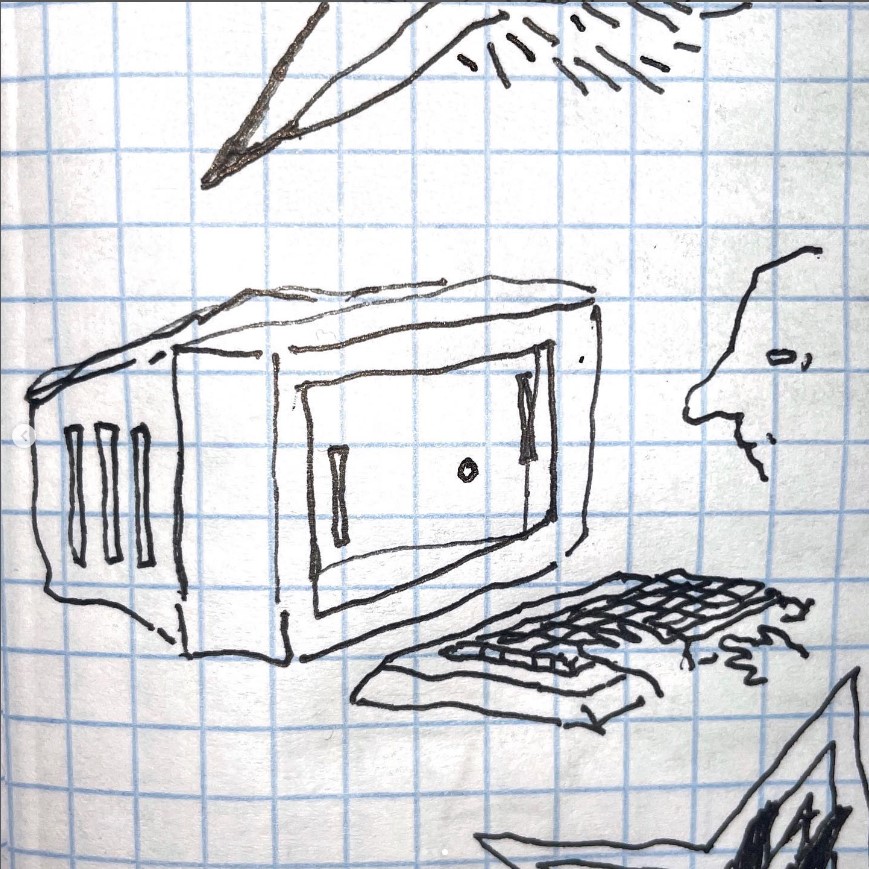
Art by Cole Fiscus
Techno-optimist authoritarianism is irresponsible and biased – note the selective, misleading, and incomplete descriptions in Andreesen’s list of successes above. Has starvation ended? Has the need for air-conditioning decreased, or does the use of air-conditioning in fact increase the need for more due to global warming? Did social media on top of the internet improve or worsen isolation and associated mental health problems?
It is biased toward short-term narrow framing – note there is no follow-up, no description of any comprehensive assessment of how the inventions as “solutions” panned out over time. Have vaccines alone touched the root causes of pandemics? What have been the full consequences and net impacts of the so-called “Green Revolution”? Are any of the gains, such as increased food production, sustainable long-term?
We can see all the pillars of the dominant science paradigm here:
Reductionism – reducing frames of reference to a narrow, bottom-up, material interpretation of causes and effects. Simple problem of cold; simple linear solution of indoor heating.
Objectivity-focus – pretending that scientists and technologists are separate from the world including society and environmental Life support systems. This ignores inter-subjective awareness of the impacts of science and technology on others. Did the Green Revolution only (or actually) solve starvation, or did it cause massive soil degradation, water pollution, destruction of family farms, and disempowerment and displacement of small landholders and in places increase starvation?
Analytical – cutting apart the world into sections to solve problems in isolation without any required synthesis to follow. The recent pandemic may have been caused in part by the COVID-19 virus, but what other factors, causes, and relationships were involved that are important for understanding the whole picture?
Mechanistic – using a single metaphor for how the world works that ignores foundational works of Rosen, Ulanowicz, and others showing clearly that living systems are not mechanistic. In their despotic domination of technology and culture, the techno-optimists have turned the world into the machine they and their associated science paradigm have imagined it to be. A machine is not alive – it exists to do work for its owner. We need to renew common sense awareness that this metaphor cannot be applied to natural living systems – ecosystems, forests, farms – or to human communities, societies, economies, and cultures. That the techno-optimists want to turn communities, societies, economics, and cultures into machines cannot serve Life or humanity, but only their own selfish profiteering and ignorant greed.

Art by Cole Fiscus
LaFrance proposes important actions to fight this crisis in industrial technology, media, and culture that is fully implicated in the global ecological multi-crisis. She wrote:
“…it has become clear that regulation is needed, not least because the rise of technocracy proves that Silicon Valley’s leaders simply will not act in the public’s best interest. Much should be done to protect children from the hazards of social media, and to break up monopolies and oligopolies that damage society, and more.”
Her recommendations go beyond government regulation:
“Universities should reclaim their proper standing as leaders in developing world-changing technologies for the good of humankind.”
We could add that universities should examine their own role, and the role of the mechanistic science paradigm they teach, in aiding and abetting the rise of authoritarian technocracy.
LaFrance calls on all of us to act:
“Individuals will have to lead the way, too… People who believe that we all deserve better will need to step up to lead such efforts.”
“…we must describe the world as we wish it to be—the problems we wish to solve in the public interest, and in accordance with the values and rights that advance human dignity, equality, freedom, privacy, health, and happiness. And we must insist that the leaders of institutions that represent us—large and small—use technology in ways that reflect what is good for individuals and society, and not just what enriches technocrats.”
She reminds us that we all have power.
“Each of us has agency.”
“No more infrastructure designed to make the people less powerful and the powerful more controlling. Every day we vote with our attention; it is precious, and desperately wanted by those who will use it against us for their own profit and political goals.”
I think the science reform described and recommended at ecosystemics.org can support LaFrance’s calls for action. I look forward to getting involved in this area of work and drawing out the connections to the global ecological multi-crisis. We will need to solve these interdependent crises together.
 ecosystemics.org
Leave a comment