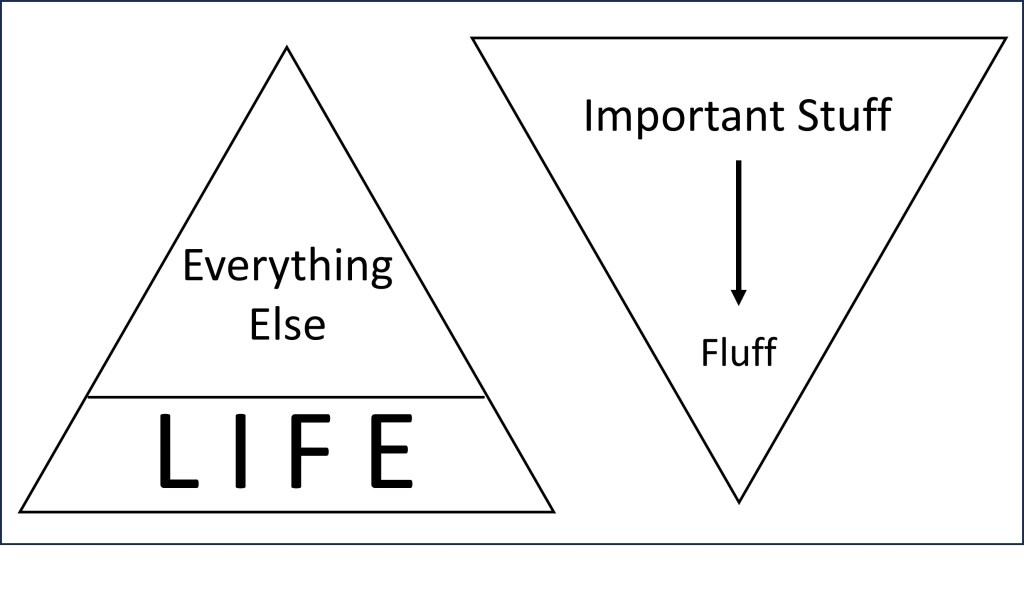
In the current global ecological multi-crisis, our challenge is to understand causes and solutions of the crisis, and best strategies for change. The challenge reminds me of the famous prayer:
“God, grant me the serenity to accept the things I cannot change,
the courage to change the things I can,
and the wisdom to know the difference.”
Attributed to Reinhold Niebuhr
Prayer, reflection, contemplation, mindfulness, and seeking guidance, inspiration, and discernment, are excellent at any time, but perhaps even more so in times of planetary crisis.
After many years of such contemplation, and seeking guidance from spiritual and scientific sources, I believe that we can change the global ecological multi-crisis. If so, then courage is called for.
Part of the discernment to “know the difference” in this case, to know this is a “thing” we can change, involves understanding a very complex and entangled multi-crisis. The wisdom and courage we need are not only to actively work for change, but also to know how to proceed in that action. I propose a strategy for action borrowed from the “inverted pyramid” strategy of writing articles like those for news reporting or blogs, which I learned about here.
Inverted pyramid writing starts an article with the most important topics and saves the “fluff”, the additional or ancillary points, for later.
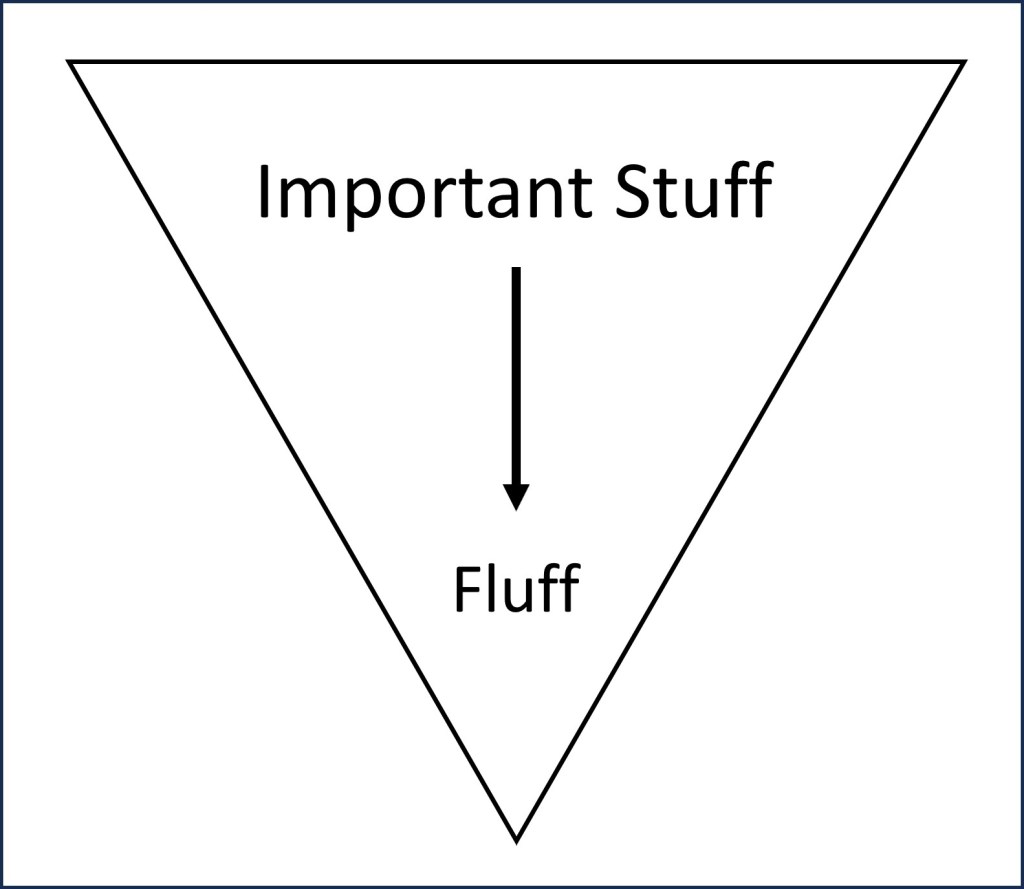
The benefits for the reader include getting the most important information quickly, and helping decide if the article is worth reading. A key benefit for the writer is to grab the reader’s attention.
An inverted pyramid strategy for change in our crisis is to work on the most important factors first, and relegate the “fluff”, the less important factors, for later.
This sounds like common sense. But, because we face a multi-crisis that is systemic and global, this action strategy takes on additional complex challenges.
To address these additional challenges successfully, it helps to orient ourselves with a clear value basis, and scientific understanding of Life, ecology, and the environment. We can again employ pyramids. A regular right-side-up pyramid is a useful way to visualize values and priorities. The one I propose goes back to Maslow’s hierarchy of needs.

Image Credit: J. Finkelstein via Wikimedia Commons
To streamline our efforts – both for efficiency and as a basis for building broad cooperation among diverse people and sectors – we can simplify Maslow’s pyramid.
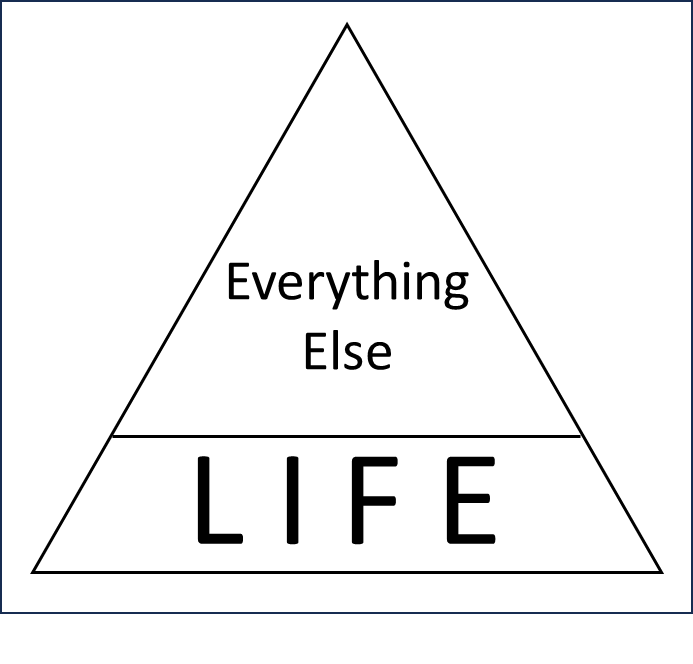
This may seem an oversimplification, but I think it is justifiable and necessary. More explanation of this pyramid is in this video recording of a presentation at the Urban Soils Symposium.
For now, I will focus on how to invert this and use it to guide action.
When we invert the pyramid to put the most important action steps first, it looks like this:
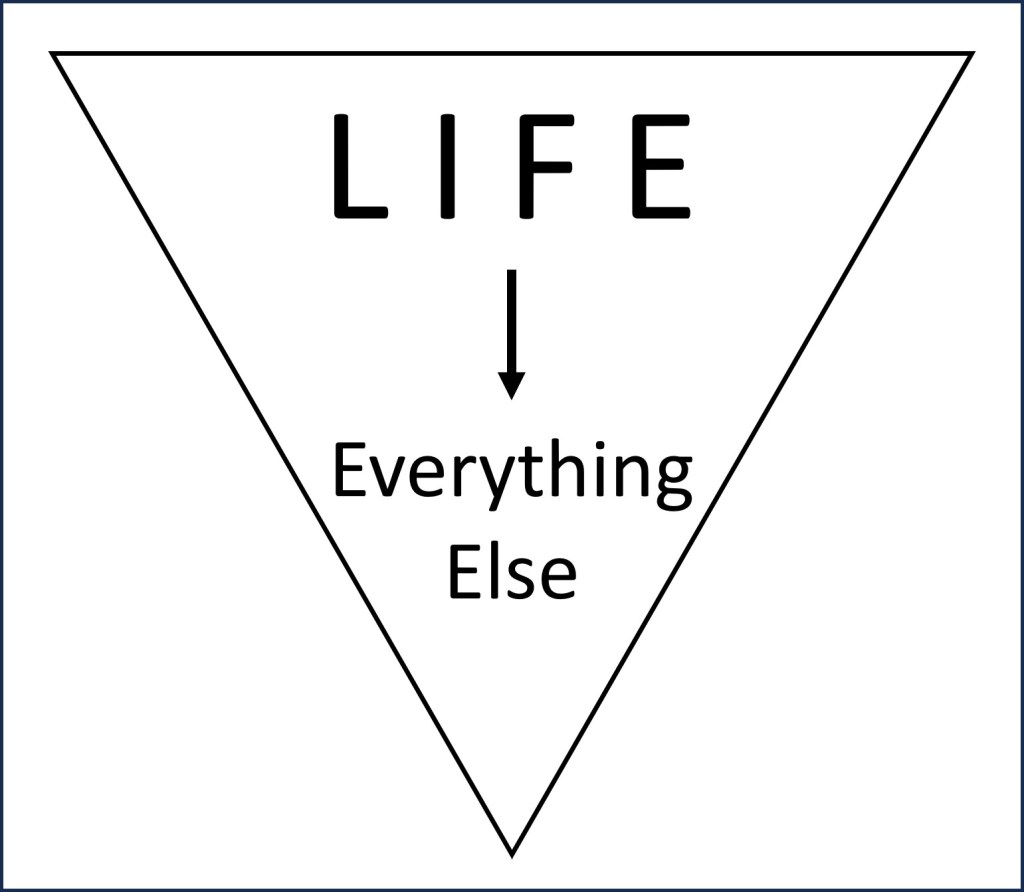
This action strategy for crisis solution is to work on the fundamental factors of Life first. The strategy promises that “everything else”, all the other needed change, will follow. This requires understanding Life as a unified whole – Life itself, Life in its unified and mutualistic relation with the Earth environment. This is where our crisis symptoms are causing alarm – climate disruption, mass extinctions, pollution, and many more. And this is where we will see signs of true progress – when these negative Life-Environment trends reverse course.
The focus on Life first has power because it provides the greatest leverage for lasting change. Working with living systems provides the most solid foundation for a future in which planetary Life support systems are stabilized and healthy.
It may seem counter-intuitive, but this makes sense in terms of how living systems are organized and are so successful. An analogous strategy from farming and gardening is “feed the soil and let the soil feed the plants”. In sustainable agriculture as well as solving systemic crisis, success comes when we create the context, when we nurture the environment, in which solutions can sprout and grow. Even more, we have to first create a context where true solutions are possible.
This strategy brings more challenges, and calls again for wisdom, serenity, and courage. To focus actions on system fundamentals and system context calls for patience and trust. We can resist the temptation for quick fixes, short-term gains, and low-hanging fruit. The focus on living systems also guides us that true solutions will not be technological or mechanistic despite the constant over-emphasis on these in industrial culture. Just as adding fertilizer is fast, but building soil organic matter and fertility will last.
We can trust this strategy by understanding core principles of living system science. Indirect mutualism is a universal organizing principle of Life in network ecology, as explained in great depth by Bob Ulanowicz (Ulanowicz 1997, Ulanowicz 2009). This principle shows that all living systems “pay it forward”, feed each other in food webs. Through autocatalytic, self-rewarding cycles, they are also paid back in the long term. Plants feed animals and decomposers, these feed the soil, and the soil feeds the plants. We can add renewable energy, recycling materials processes, and net improvement of environmental quality to form a concise set of interdependent living system basic principles to follow (Jørgensen et al. 2015).
Another challenge is to start work, and pursue work long term, knowing that the work won’t be finished in our lifetimes. This approach to action stems from a value basis grounded in Life and knowing the difference between, and the complementary unity of, discrete Life and sustained Life. As described in the post on infinite games we humans have finite lives, but we participate in the ongoing game of Life that extends far before we were born and far after we will die.
We could think of discrete Life of an individual person associated with “self” or the “small self”, and sustained Life, all Life, as associated with “Self” or the “Great Self”. To assert values, and to think, choose, and act from the perspective of our connection to Great Self requires discipline, maturity, and serving others as well as caring for ourselves. It requires serenity, wisdom, and courage.
The ability and willingness to entertain and make long-term and seemingly “impossible” plans may be a necessary step for success to become possible. People may be unwilling to discuss or entertain systemic change and ultimate goals because they deem such deep and largescale system change to be impossible. This reluctance may come from thinking mainly from the short term, one lifetime, “small self” point of view. This is natural and common, but our times call for something more.
Why do we shy away from considering the ultimate goal, the true solution, systemic transformation, building the lasting foundation for sustainable and healthy Life on Earth? Is it because the “normal” way of industrial culture is to think, speak, and agree together that the “practical” way to work is incremental, analytical, divide-and-conquer? We may need to face the irony that our lack of true progress reveals. This approach is not the “practical solution” – it is linked to, grows from, and causes the systemic problem. The “wisdom to know the difference” suggests that we flip the script, invert the pyramid, change our minds, and act courageously.
References cited
Jørgensen, S.E., B.D. Fath, S.N. Nielsen, F.M. Pulselli, D.A. Fiscus, and S. Bastianoni. 2015. Flourishing Within Limits to Growth: Following Nature’s Way. EarthScan/Routledge, London, 236 pp.
Ulanowicz, R.E., 1997. Ecology: The Ascendent Perspective. Columbia University Press, New York, NY, 201 pp.
Ulanowicz, R.E., 2009. A Third Window: Natural Life beyond Newton. Templeton Foundation Press, West Conshohocken, PA, 224 pp.
 ecosystemics.org
Leave a comment